Tate Press: Video Tutorial & Exercise Guide

| Workout | Tate Press |
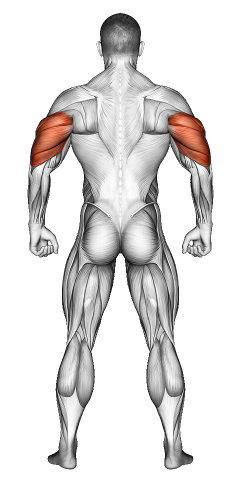
| Primary Muscle Group | Triceps |
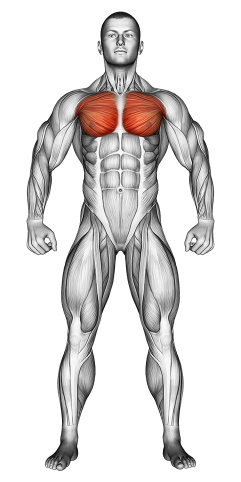
| Secondary Muscle Group | Chest |
| Equipment Required | Dumbbell |
| Force Type | Push |
| Mechanics | Isolation |
| Exercise Type | Strength |
| Difficulty | Intermediate |
Tate Press: Video Tutorial & Exercise Guide
Secondary Muscles Group
Tate Press: Step-by-Step Guide
- Step 1: Lie back on a flat bench, holding a dumbbell in each hand. Start with the dumbbells extended directly over your chest, with your palms facing your feet.
- Step 2: Bend your elbows outward and lower the dumbbells toward your chest, keeping them close to your body. Your palms should face each other, and your elbows should point outward.
- Step 3: Continue lowering the dumbbells until they reach your chest, and your elbows form approximately a 90-degree angle. Keep your upper arms stationary.
- Step 4: Push the dumbbells back up to the starting position by extending your arms. Focus on squeezing your triceps at the top of the movement.
- Step 5: Repeat for the desired number of reps, maintaining control and focusing on engaging your triceps throughout the exercise.
Tate Press: Overview
The Tate Press is a unique tricep isolation exercise that specifically targets the medial head of the triceps. By using a pressing motion with dumbbells and keeping your elbows flared outward, the Tate Press helps build strength and muscle mass in the back of the arms, making it an effective exercise for tricep development.
This movement can be incorporated into any upper-body or arm workout routine, and it is particularly useful for improving pressing strength in exercises like the bench press and overhead press. It’s also a great exercise for adding variation to your tricep training.
Tate Press: Benefits
The Tate Press primarily targets the triceps, specifically the medial head, which is often underdeveloped compared to other tricep exercises. This movement is excellent for building overall tricep strength and size, helping to create balanced arm development.
The exercise also engages the elbow stabilizers, promoting joint health and reducing the risk of injury in other pressing movements. By keeping your elbows flared, the Tate Press puts more focus on the triceps than traditional pressing movements.
This exercise can be performed with relatively light weights, making it a safer option for those looking to avoid excessive strain on their joints while still achieving excellent tricep activation.
Tate Press: Pro Tips & Advanced Techniques
Focus on keeping your elbows flared outward and your upper arms stationary throughout the movement. Avoid using too much weight, as this can compromise your form and reduce the effectiveness of the exercise. For an added challenge, try pausing briefly at the bottom of the movement to increase time under tension or perform tempo reps by slowing down the lowering phase. Ready to hit your triceps with a unique angle? Let’s press!
Tate Press: Progression Plan
Beginner
Intermediate
Advanced
Tate Press: Frequently Asked Questions (FAQs)
What muscles do Tate Presses target?
+Tate presses primarily target the triceps, with a particular focus on the medial head. The exercise also engages the elbow stabilizers.
Are Tate Presses suitable for beginners?
+Yes, Tate presses are suitable for beginners, but it’s important to start with light weights to master proper form. Keeping the elbows flared is key to maximizing tricep engagement.
How can I make Tate Presses more challenging?
+To increase the difficulty, use heavier dumbbells, slow down the tempo of the reps, or incorporate pauses at the bottom of the movement. You can also perform supersets with other tricep exercises for added intensity.
How often should I include Tate Presses in my routine?
+Tate presses can be included 1-2 times per week as part of your arm or upper body workout. Pair them with other tricep exercises like dips or tricep pushdowns for a comprehensive tricep routine.
What common mistakes should I avoid when doing Tate Presses?
+Avoid using too much weight, as this can compromise your form and reduce the effectiveness of the exercise. Keep your elbows flared out and avoid letting your upper arms move during the movement to fully engage the triceps.